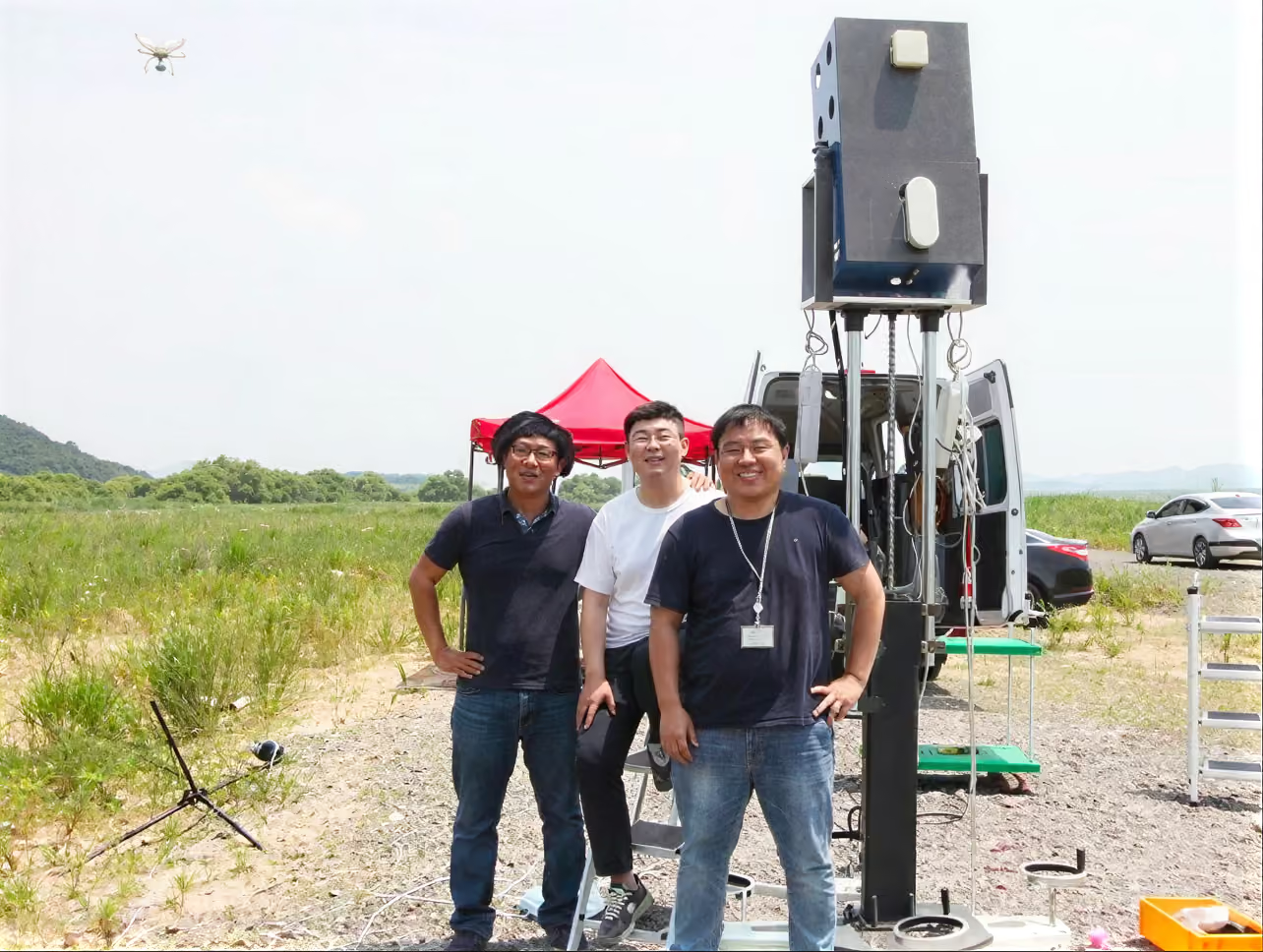
DGIST research team after a field test. Senior Researcher Dae-gun Oh is pictured with two fellow researchers. Photo: Daehak Journal.
A research team led by Senior Researcher Dae-gun Oh of DGIST’s Collaborative Robotics Research Center has developed a drone-detection radar system capable of identifying tiny drones flying more than 3 kilometers away, in cooperation with Professor Young-wook Kim of California State University, Fresno. The system was expected to strengthen domestic drone-detection technology and support defense readiness.
In 2016, DGIST researchers developed Korea’s first independent radar system capable of detecting drones over 200 meters away. Their latest system employs domestic technology to detect small Phantom drones measuring approximately 55 × 55 × 40 centimeters at distances exceeding 3 kilometers.
For greater detection range, the team combined AESA radar technology with ultra-high-resolution radar signal processing for accurate target positioning. The system successfully detected drones more than 3 kilometers away.
The team also planned to develop radar recognition technology using generative adversarial networks (GANs), a type of deep-learning AI algorithm expected to enhance target identification. GANs can generate data that resembles limited observed examples, enabling improved recognition even with a small training dataset.
During the development process, the team collaborated with Korean small and medium-sized companies on key hardware such as radar transmitters, receivers, antennas and signal-processing platforms, offering prospects for domestic technological independence.
Oh said the achievement resulted from close cooperation with domestic companies and the development of proprietary radar signal-processing algorithms. He added that the team would continue seeking to elevate Korean radar technology’s position in the global market.
The work was conducted jointly with Professor Kim’s California-based team under a DGIST research program supported by the Ministry of Science and ICT since 2017. Its radar recognition results appeared in IEEE Geoscience and Remote Sensing Letters.