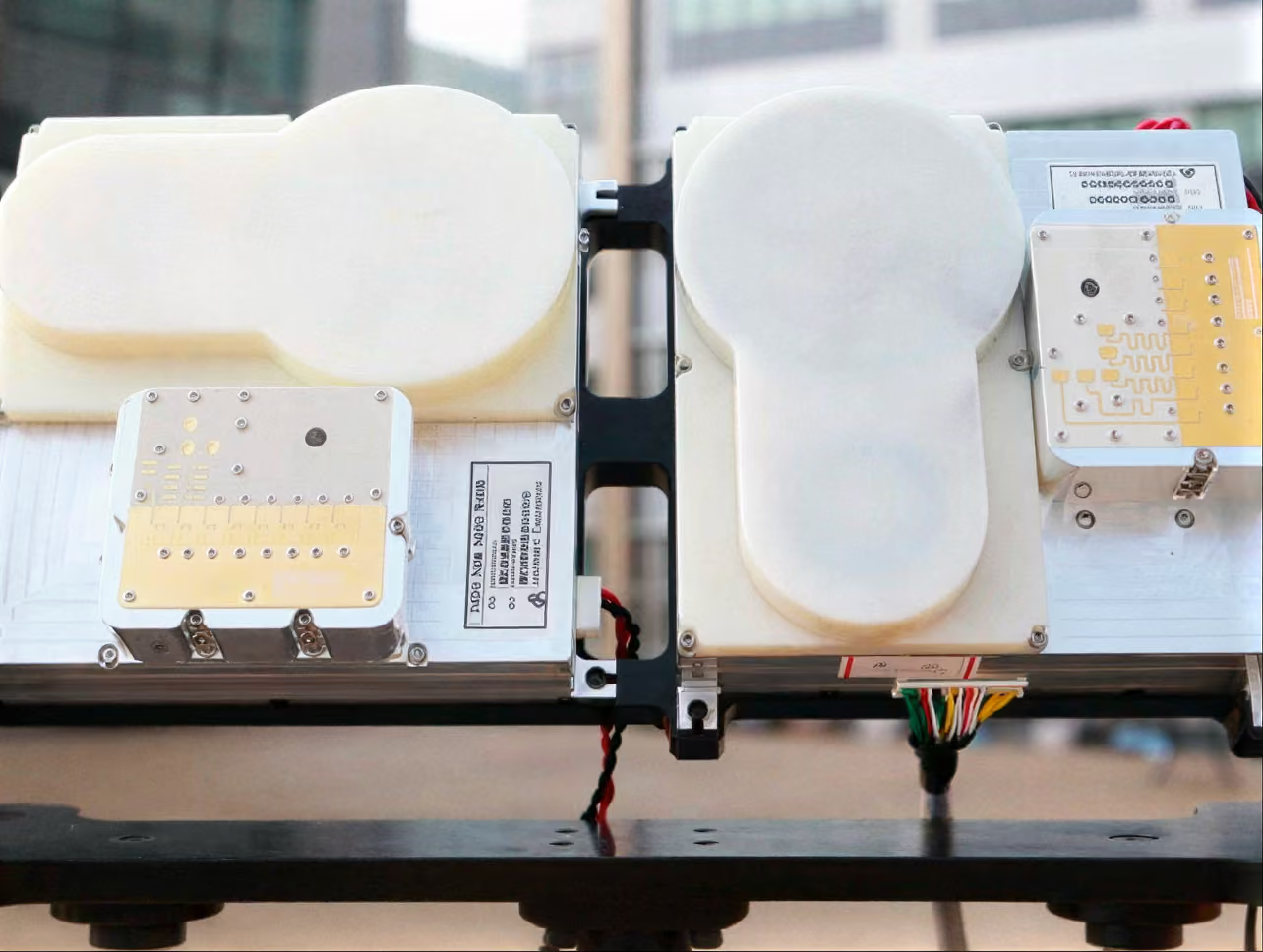
Dual-channel high-resolution radar platform developed by the DGIST research team. Photo: DGIST.
A DGIST research team has developed ultra-high-resolution radar technology capable of detecting drones flying over cities. The team, led by Senior Researcher Dae-gun Oh of the Robotics Systems Research Division, announced on June 15 that it had developed a dual-channel ultra-high-resolution radar using two radar receiving channels to detect and recognize distant objects in real time.
When implemented on a frequency-modulated continuous-wave (FMCW) radar platform with an L-shaped patch antenna, the technology can detect low-altitude unmanned aircraft within a radius of 200 meters.
As small unmanned aerial vehicles become increasingly common worldwide, the need for low-altitude radar and signal-processing systems to manage flights over cities has attracted growing interest. Global defense companies, including the UK's Blighter and Israel’s RADA, had been developing related radar technologies, while Korean research remained limited.
Unlike conventional large radar systems that use numerous antennas to improve resolution, the research team designed an algorithm that makes use of just two receiving channels. This reduced hardware requirements while successfully enabling high-resolution signal processing based on a multidimensional partial-space estimation approach.
Ultra-high-resolution radar operating with two channels can detect and recognize low-flying objects in real time. The electromagnetic radiation from the radar was described as being comparable to that of a mobile phone, making it suitable for drone-detection applications in urban centers.
The research was published online in IEEE Transactions on Aerospace and Electronic Systems (IEEE TAES), an international academic journal in the radar field.
The researchers are continuing work toward a low-altitude radar system with a detection range of up to 10 kilometers. They are also pursuing joint research with domestic defense companies on multipurpose compact radars and military through-wall radars to promote the practical commercialization of Korean radar technology.
Oh commented that by developing low-altitude radar and through-wall radar signal processing with independent technology, the team had secured domestically developed dual-channel ultra-high-resolution radar technology. He said it would support future research into radar for small unmanned aircraft and the construction of a safer society.